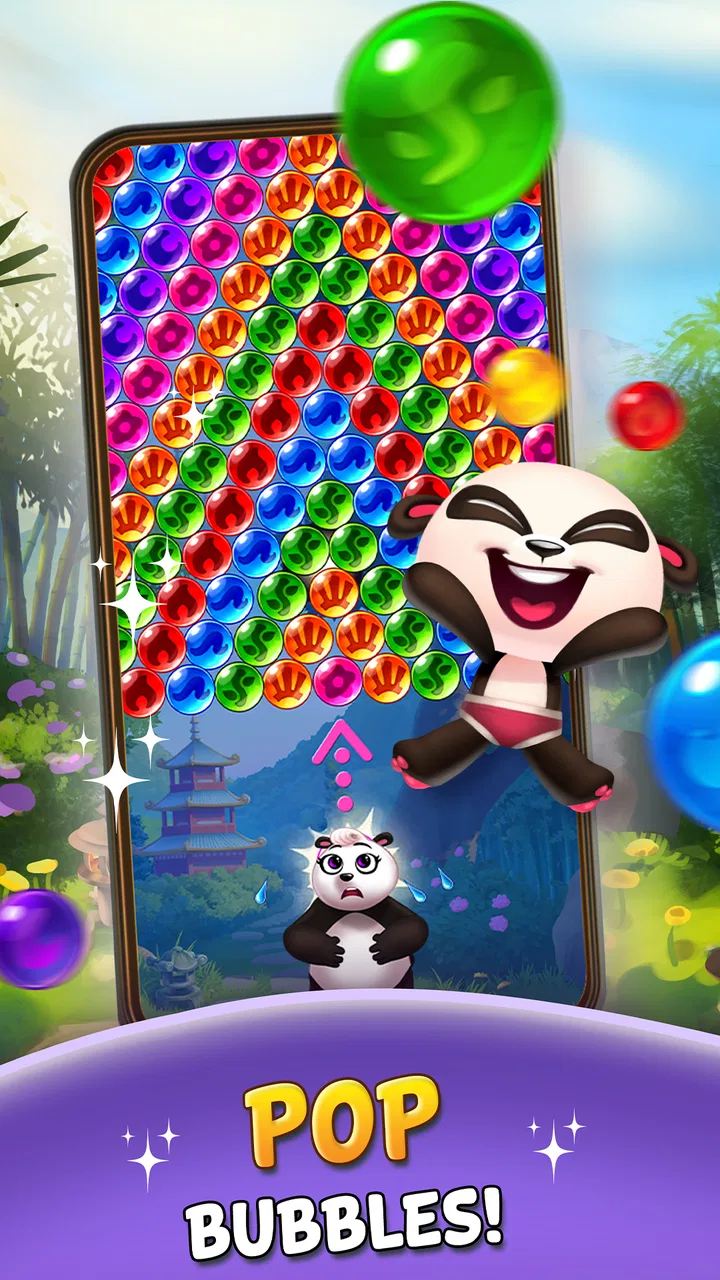
Bubble Shooter: Panda Pop!
- 4.7
- Rating
- 50.00M
- Installs
- Free
- Price

 Analysis by App-foxy
Bubble Shooter: Panda Pop! is the kind of puzzle game I can open with no preparation, play for a few minutes, and understand immediately. The basic idea is familiar: aim a launcher, match bubbles by color, and clear the board before the arrangement becomes difficult to manage. What makes it appealing is not a complicated rule set, but the quick feedback after every shot. A good angle can remove a cluster in seconds, while a careless bounce can leave the next move much harder.
That simplicity makes it a comfortable choice when I want a light game rather than a demanding hobby. I do not need to remember a story, learn a large skill tree, or wait for a long tutorial before making meaningful decisions. At the same time, it is not completely mindless. The best shots usually come from looking beyond the nearest group and considering how the board will change after bubbles fall away.
Jam City, Inc. presents this as a free puzzle game for everyone, and that description fits my experience. It is available for Android devices running at least Android 7.0, with a current version listed as 15.000.100. The game has built a very large audience, with over 50 million installs, an average rating of 4.6, and around 1.2 million ratings. Those figures do not replace personal judgment, but they do suggest that the straightforward bubble-shooting format has remained attractive to a broad range of players.
You May Also Like

 Blood Strike: 2.5 Anniversary
Blood Strike’s Loadouts Turn Every Drop Into a Tactical Gamble
A close look at Blood Strike’s custom loadouts: how fast access to signature weapons reshapes its battle royale rhythm, rewards preparation, and narrows the gap between fights.

 Pandora - Music & Podcasts
Pandora’s Music Is Easy to Start, but Harder to Recover
Pandora’s strength is its low-effort path from a seed to a station. Its weak spot is how much confidence it asks you to place in connection, setup, and quiet recovery.

 8 Ball Pool
 Is Built on Rivalries, Rematches, and Routine
A close look at the rivalries, rematches, shared routines, and unanswered safety questions that turn a quick pool match into a persistent mobile community.

 Samsung Music
’s Quiet Strength Is Playing What You Already Own
Its reach comes less from spectacle than from dependable access to a personal library. That simplicity is both the app’s strongest retention engine and its ceiling.

 AccuWeather: Weather Radar
AccuWeather Review: A Quick, Clear Forecast for Everyday Decisions
For everyday plans, the best forecast is the one you can understand quickly. AccuWeather makes rain timing, radar, and local conditions easy to act on, with a few trade-offs.

 Hill Climb Racing
Why Hill Climb Racing Still Turns Crashes Into One More Run
A tiny car, a bumpy hill and one more upgrade: Hill Climb Racing keeps resurfacing because its simple chaos makes every near-miss feel personal.
More From Our News Desk



Why the first few minutes work so well
The strongest part of the game is its immediate readability. Bubbles are visually distinct, the launcher communicates the direction of the shot, and the objective is easy to understand without stopping to study instructions. I can begin playing while waiting for a coffee, sitting on public transport, or taking a short break between tasks. There is very little mental overhead between opening the game and making the first useful move.
That instant access is especially valuable on a phone. Some puzzle games feel cramped or require too much concentration for a small screen, but this format depends on a compact play area and a single clear action. I can focus on the next shot without needing to manage several controls at once. The result is a pleasant sense of control, even when the board itself becomes complicated.
The early enjoyment comes from small successes rather than long-term planning. Matching a few bubbles feels satisfying, and larger clears provide a stronger burst of feedback. I like that the game can reward a simple shot while still leaving room for better play. A player who only wants a relaxing diversion can follow the obvious matches, while someone who enjoys puzzles can search for bank shots, supporting bubbles, and more efficient ways to open the board.
There is also a useful distinction between seeing a possible match and being able to reach it. A group may sit behind another color, forcing me to decide whether to remove the obstruction or use the wall to approach from an angle. That small layer of geometry keeps the action from becoming a purely automatic color-matching exercise.
For a short-session game, this is an important strength: the rules are simple enough to enter quickly, but the shot itself still asks for a little judgment. I do not need a long uninterrupted period to enjoy it. One successful chain can be enough to make a brief visit feel worthwhile.
A rhythm built around one decision at a time
Each shot creates a compact cycle. I look at the current colors, check the available angle, decide whether to play aggressively or safely, and then watch the result. That rhythm is easy to follow and naturally supports short sessions. There is no need to memorize a large sequence of moves because the board changes after each action.
I find the most interesting decisions happen when the obvious match is not the best match. Clearing a small group may be tempting, but attaching bubbles to a larger cluster can produce a much better result later. In other situations, a risky angle might open a route to a difficult color, while a conservative shot simply delays the problem. The game is at its best when I pause for a second and treat the next move as a small spatial puzzle rather than firing immediately.
A practical tip is to inspect the upper structure before aiming at the lowest visible group. If a section is held in place by only a few connections, removing those supports can clear more than a direct match. This is one of the less obvious habits that improves play: the visible target is not always the most valuable target.
I also try to preserve useful colors when the board gives me a choice. Spending a rare matching color on a small group can leave an awkward arrangement for the following shots. Waiting for a better opportunity is not always possible, but recognizing that trade-off makes the game feel more deliberate. It is a small lesson in resource timing hidden inside a very accessible format.
The controls are forgiving enough for casual use, but precision still matters. A shot that looks correct at first can land differently if the angle is slightly off. Wall bounces are particularly useful when a direct route is blocked, yet they also create the sort of mistake that feels understandable rather than random. When I lose because I rushed an angle, I usually know what I could have considered first.
Why it handles interruptions better than many puzzle games
Bubble Shooter: Panda Pop! suits people whose gaming time is frequently interrupted. If I need to put the phone down after a single move, the game’s basic structure is easy to resume because the board itself shows the current problem. I do not have to reconstruct a complicated chain of actions or remember a story conversation. Returning after a distraction feels more like picking up a small visual puzzle than restarting a demanding task.
This quality matters in ordinary situations. I might open it while waiting for an appointment, get called sooner than expected, and leave immediately. Later, I can come back and understand the board again after a quick glance. That makes it more practical than games that depend on long rounds or continuous attention.
The same simplicity can help when playing with limited concentration. After a tiring day, I can still recognize colors and angles without committing to a major challenge. However, the game is not entirely interruption-proof in the broader sense. A shot is still an action with consequences, so I prefer to make it when I have a moment to look properly. The game is easy to pause mentally, but not every move should be made while distracted.
Its offline positioning is another reason it fits short visits. The store summary emphasizes play without Wi-Fi, which makes it useful in places where a connection is unreliable or unavailable. I would still avoid assuming that every surrounding service behaves exactly the same way offline, especially where optional purchases or account-related functions may be involved. For the core bubble-shooting experience, though, the ability to play without depending on a live connection is a meaningful convenience.
That offline focus also changes how I think about the game. It is not something I need to reserve for a stable home connection or a long evening. It works better as a pocket activity: open it, solve a few boards, and close it when real life demands attention.
Replay value is steady, but not endlessly varied
The main limitation is repetition. The pleasure comes from aiming, matching, and clearing bubbles, so the central action remains recognizable throughout. That consistency is exactly why the game is easy to learn, but it also means players who need constant novelty may eventually feel that the routine has settled into a pattern.
I do not see this as a flaw for everyone. Repetition can be the point of a casual puzzle game. Similar to doing a short crossword or a familiar daily brain exercise, the predictable structure can be calming. I can return because I know the kind of attention it requires. The question is whether that comfort feels relaxing or monotonous to the individual player.
For me, replay value depends on the quality of the board in front of me. A layout that forces careful angles remains engaging, while a sequence of obvious matches can feel more like maintenance. When I notice myself firing without looking, I take that as a sign to stop rather than expecting the game to create excitement by itself.
One useful way to extend the challenge is to play for efficiency instead of merely clearing the board. I can aim to use fewer careless shots, preserve better angles, or solve a difficult section without relying on repeated trial and error. This changes the personal goal even when the basic mechanics stay the same. It is not a new mode, but it gives experienced players a reason to pay closer attention.
Another tip is to avoid treating every available match as urgent. Sometimes the better move is to create a setup for the next color rather than immediately removing what is easiest. This approach makes familiar boards more interesting and reduces the feeling that I am simply following the most obvious option.
Still, players looking for deep character development, competitive multiplayer, or a constantly changing strategic system should probably choose another puzzle category. This game’s appeal is concentrated in its accessible shooting and matching loop. It does not try to be a broad all-purpose gaming experience, and I think it is better judged on how well that focused loop serves brief, casual play.
Free access and the question of spending
The game is free to download and play, which lowers the barrier to trying it. That is important for a casual title because I can test the controls and session rhythm before deciding whether it belongs on my regular rotation. The age rating is Everyone, so it is positioned as an approachable option for a wide audience rather than a game aimed at a narrow adult niche.
There are in-app purchases ranging from $0.99 to $99.99 per item. That range is worth considering before handing the game to a child or to someone who tends to make impulse purchases. I recommend treating optional spending as a firm personal limit rather than assuming that a free download will remain entirely cost-free in practice.
My preferred way to use a game like this is to enjoy the basic loop without letting progress pressure decide when I spend money. If a difficult board makes me impatient, I would rather close the app and return later than turn a short distraction into an unnecessary purchase. The game is most enjoyable when the decision to continue comes from wanting another puzzle, not from feeling pushed to pay for relief.
This is also where it differs from some minimalist puzzle alternatives. A paid, one-time game may offer a cleaner experience for readers who dislike purchase prompts or progression pressure, even if it lacks the same broad accessibility. On the other hand, a free bubble shooter is easier to sample and may be a better fit for someone who only plays occasionally.
Who will enjoy it, and who should skip it
I would recommend it to anyone who wants a clear, low-commitment puzzle game with immediate visual feedback. It works particularly well for players who enjoy aiming challenges but do not want the complexity of a strategy game. It is also a good match for people who play in fragments: a few minutes during a break, a short session while traveling, or an occasional offline game when connectivity is inconvenient.
Parents and families may appreciate the Everyone rating and straightforward rules, but I would still pay attention to the purchase range and establish device-level spending controls when appropriate. The game itself is easy to understand; the more important practical question is whether the person using it can manage optional purchases responsibly.
I would suggest skipping it if you need a game with a strong narrative, a deep competitive ladder, or a radically different experience every time you open it. I would also look elsewhere if repeated color matching quickly loses its charm. A more experimental puzzle game may offer greater variety, while a premium alternative may be preferable for someone who wants a quieter, less commercially oriented experience.
Compared with traditional match-three games, the appeal here is the physical act of aiming. Instead of swapping pieces and immediately seeing the board react, I have to judge trajectory and decide how much of the structure I want to disturb. Compared with more complex bubble shooters, its value is the low learning curve and easy return after interruptions. The trade-off is that the familiar formula may not provide enough depth for players seeking long strategic sessions.
My everyday way of playing
In a typical short session, I open the game with one simple goal: solve a handful of boards without rushing. I first scan for hanging sections and colors that can unlock a larger area. Then I check whether a wall bounce offers a safer route than a direct shot. If the board is especially awkward, I make the most informative move rather than the most dramatic one, using the result to understand what the next shot should accomplish.
I try not to play while walking or during a conversation because the game rewards a moment of visual attention. It is casual, but the difference between a clean angle and a wasted shot can be significant. When I am waiting somewhere, I can give it that attention without needing to reserve a full block of time.
When an interruption arrives, I stop rather than forcing one final move. The board is simple enough to read again later, and that is one of the reasons the game remains useful in real life. It does not punish me for having an uneven schedule as harshly as a long-form game might.
After several sessions, I judge the experience less by whether it surprises me and more by whether it still gives me a satisfying decision quickly. On good days, the answer is yes. A clever bounce or a well-timed color match can make a two-minute visit feel complete. On days when the boards feel too familiar, I simply move on without feeling that I have abandoned a large commitment.
My final take on this casual puzzle
Bubble Shooter: Panda Pop! succeeds because it understands the value of a fast start. The rules are clear, the shots are tactile, and the board communicates enough information for me to make decisions without a long explanation. Its offline-friendly positioning makes it practical for travel and unreliable connections, while the short-turn structure makes interruptions manageable.
The weaknesses are just as clear. The core loop can become repetitive, and the presence of in-app purchases means I would use sensible spending boundaries. Players who want a richer story, more varied systems, or a completely purchase-free premium experience may be happier elsewhere.
For my own casual gaming habits, it earns a recommendation as a dependable short-session option. If you want immediate puzzle action that you can enter, pause, and leave without much ceremony, this is a strong fit. I would not call it the most ambitious puzzle game on a phone, but ambition is not really its purpose. Its best quality is that it gives me a small, understandable challenge whenever I have a spare moment, and it usually gets to the fun before that moment disappears.
FAQs for Bubble Shooter: Panda Pop!
01What is Bubble Shooter: Panda Pop! and how do you play it?
Bubble Shooter: Panda Pop! is a puzzle game where players aim to rescue adorable pandas trapped in bubbles. The gameplay involves shooting colored bubbles to make matches of three or more, which pop and clear the board. Each level presents unique challenges, with increasing difficulty and special power-ups to assist players in their mission.
02Is Bubble Shooter: Panda Pop! free to download and play?
Yes, Bubble Shooter: Panda Pop! is free to download on both Android and iOS platforms. While the game is free to play, it offers in-app purchases that can enhance the gaming experience. These purchases include power-ups, extra lives, and other bonuses to help players progress through challenging levels more easily.
03Are there any in-app purchases in Bubble Shooter: Panda Pop!?
Bubble Shooter: Panda Pop! includes a variety of in-app purchases. Players can buy power-ups, additional lives, and special boosters to help them overcome difficult levels. Prices for these purchases vary, and while they can enhance gameplay, they are not necessary to enjoy or complete the game.
04Does Bubble Shooter: Panda Pop! require an internet connection to play?
Bubble Shooter: Panda Pop! can be played offline, allowing players to enjoy the game without an active internet connection. However, certain features, like accessing leaderboards, social features, or making in-app purchases, will require an internet connection to function properly.
05What age group is Bubble Shooter: Panda Pop! suitable for?
Bubble Shooter: Panda Pop! is suitable for players of all ages, making it a family-friendly game. Its easy-to-understand mechanics and colorful graphics appeal to younger audiences, while its strategic elements and increasingly challenging levels can captivate older players as well. Parental guidance is suggested due to in-app purchases.
Pros
- Engaging and colorful graphics.
- Simple and intuitive controls.
- Regular updates with new levels.
- Fun for all age groups.
- No internet required for gameplay.
Cons
- In-app purchases can be expensive.
- Ads can be intrusive at times.
- Limited lives can halt progress.
- Some levels feel repetitive.
- Occasional performance lags.

Bubble Shooter: Panda Pop!
Gallery